You are sitting on your patio enjoying a drink when a sudden gust of wind comes out of nowhere. The awning fabric snaps tight, the frame groans, and you watch your shade structure start shaking like it wants to take flight. Most homeowners never think about wind resistance until that moment, but by then it is too late.
The problem is that awning installers rarely explain the physics behind what makes an awning fail or survive. They mount it, collect your money, and leave you guessing when the weather turns. Wind does not care about your warranty or how much you paid for the awning, it only cares about how well it was designed and installed.
So how windy is too windy for an awning and what awnings can withstand wind before they become a flying hazard? The answers are not as simple as a single number. This guide breaks down what most installers never explain about wind load and why your awning might be one strong gust away from disaster.
What Is Wind Load and Why Does It Matter for Awnings?
Before we get into specific wind speeds and product ratings, you need to understand one simple concept. What is wind load in awning design? It is the force that moving air places on your awning’s fabric, frame, and mounting hardware. Think of it like this. Your awning works as a shade on a calm day, but when the wind picks up, that same fabric turns into a sail. And sails are designed to catch wind, which is the last thing you want attached to your house.
The problem starts because most people only think about the awning itself, not the invisible force working against it. Wind load on awning calculations take into account the size of the fabric surface, the angle it sits at, how far it projects from the wall, and even the type of fabric.
The difference between a safe awning and a failed one often comes down to whether the installer bothered to calculate wind load on awning before bolting it to your house. Without that calculation, you are guessing. And guessing with wind loads is how awnings end up on the ground or hanging sideways after the first real storm.
How Wind Actually Affects Your Awning (It’s Not Just About Downforce)
Most people assume wind pushes down on an awning. That is not the whole story. In fact, the more dangerous force is the opposite. Wind uplift forces on awnings happen when air moves over or under the fabric, creating suction that pulls the awning upward. Imagine holding a piece of paper flat in a breeze. It does not push down, it lifts. The same principle applies to your awning.
How wind affects awnings comes down to a few key factors.
Flat vs Angled Installation
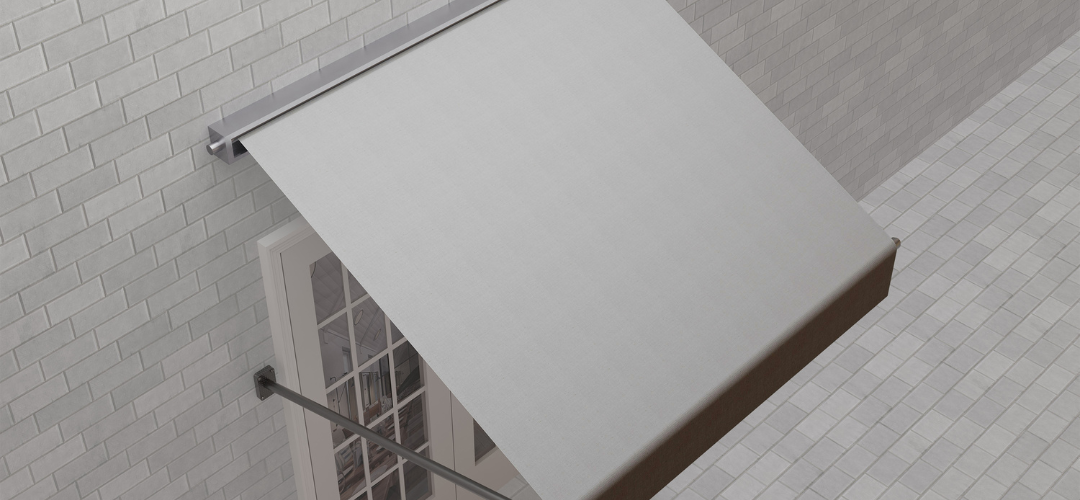
A flat awning with a shallow pitch allows wind to get underneath, where it gets trapped and creates upward pressure. Angled awnings allow wind to flow over the top instead of getting caught underneath.
Projection Length
The lever effect is simple physics. An awning that projects six feet from your wall creates leverage at the mounting points. A ten foot projection multiplies that force even more. What wind speed can an awning withstand depends largely on how far it sticks out. Shorter awnings almost always handle wind better.
Location and Surroundings
An awning installed on an exposed wall faces different wind pressures than one tucked into a courtyard. Wind swirls around buildings, accelerates through narrow gaps, and hits from unexpected angles. Wind pressure on fabric structures is not constant or predictable, which is why awnings fail in ways that surprise homeowners.
Fabric Tension and Type
Loose fabric catches wind and billows, which acts like a whip against the frame. Tight fabric allows wind to flow across the surface more smoothly. Heavier fabrics also resist flapping better than lightweight materials.
The Wind Speed Rating Problem – What Most Manufacturers Won’t Tell You
You have seen the numbers in product brochures. This awning can handle 30 mph winds. That one claims 40 mph. But what is the wind speed rating for awnings? And can you trust those numbers? The honest answer is more complicated than most homeowners realize.
Ratings Assume Perfect Installation
Those wind speed ratings assume your awning is mounted into solid structural framing, not just siding or brick veneer. They assume the hardware is perfectly aligned and torqued. They assume the fabric tension is perfect. In the real world, none of those conditions are guaranteed. Outdoor awning wind rating numbers can be misleading without context about how your awning was installed.
The Rating vs Reality Gap
A 30 mph rating does not mean your awning is safe the moment the wind hits that speed. It means the awning was tested in a controlled environment under ideal conditions. Gusts, direction changes, and nearby structures that funnel or redirect wind all change how your awning performs. Load-bearing capacity of awnings is not a switch that flips from safe to unsafe at a certain number. It is a gradual scale, and every installation is different.
What to Look for Instead
Rather than chasing a high number, ask your installer for the canopy structural design specifications. What is the frame made of? How are the arms reinforced? What is the actual breaking point of the mounting hardware? A well built awning with a modest rating will outlast a cheap awning with an inflated number every time. High wind awnings earn that label through better engineering, not bigger claims.
Awning Design Features That Improve Wind Resistance
Not all awnings are built the same. Some are designed to handle wind, while others are barely sturdy enough for a breezeless afternoon. Awning design for wind resistance starts with the right frame and fabric choices before you even think about mounting.
Frame Material and Arm Design
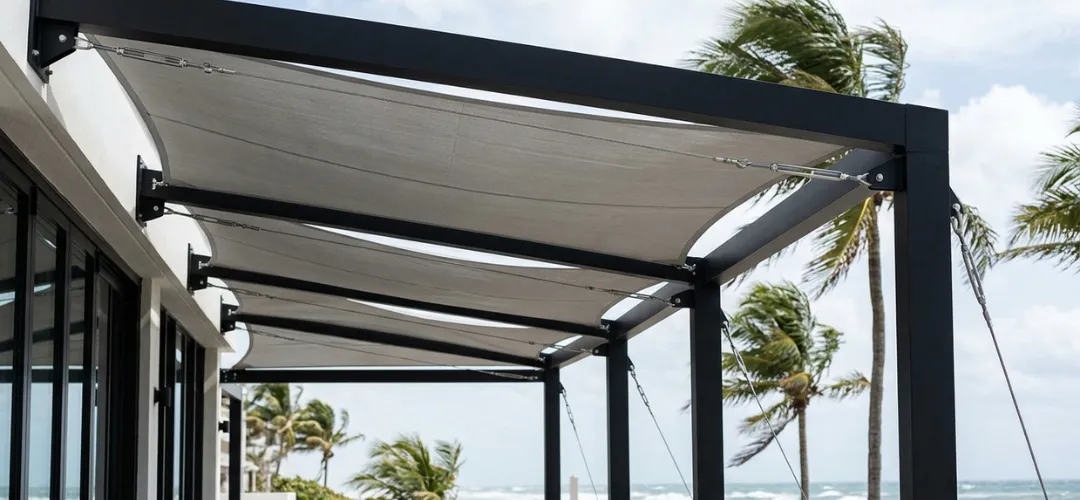
Aluminum frames are lighter than steel but can still be strong when engineered correctly. The arms that hold your awning open matter just as much as the frame. Cable driven arms rely on tension that can degrade over time. Rigid arms with heavy duty hinges absorb wind stress much better. For windproof awnings, look for thick walled aluminum or reinforced steel components.
Pitch Makes a Difference
A flat awning catches wind like a sail. A steeply pitched awning allows wind to flow over the top instead of getting trapped underneath. What awning is best for high winds? One that you can angle steeply when the weather turns.
Fabric Tension and Material
Loose fabric flaps, and flapping acts like a whip against the frame. Awning design for wind resistance includes keeping the fabric taut through springs or tensioning systems. Heavier acrylic fabrics also hold up better than lightweight polyester in gusty conditions.
Reinforced Mounting Points
The strongest awning in the world will fail if it is attached poorly. Best awning for windy conditions includes not just the awning itself but how it connects to your house. Spreader plates, through bolts into structural framing, and load distributing brackets all make a difference.
Real-World Wind Load Examples (What the Numbers Mean)
Let us put some actual numbers on these concepts so you can see how wind load changes with size and installation.
Example 1: The 6 Foot Awning
A six foot awning projecting from your wall creates relatively low leverage at the mounting points. At 25 mph wind speed, the force on the wall mounts might be manageable. Wind load on canopy of this size, assuming proper installation and a steep pitch, usually stays within safe limits for most structures.
Example 2: The 12 Foot Awning
Double the projection, and the force at the wall mounts does not just double, it multiplies. A canopy wind load example with a long projection means the same wind speed creates significantly more leverage. That 12 foot awning could experience three or four times the uplift force of the 6 foot model. This is why wind load on canopy attached to building becomes critical to calculate before installation.
What the numbers teach us
- Shorter awnings handle wind better than longer ones
- Steep pitches reduce uplift compared to flat installations
- Exposed locations (rooftops, open fields) need stronger hardware than sheltered patios
- Awning wind load calculation is not optional for larger awnings in windy regions
How to Choose an Awning for Windy Conditions
If you live somewhere that gets regular wind, your buying decisions need to be different. Here is what actually matters.
Ask about the frame
Aluminum or steel? Thick walls or thin? Welded corners or bolted? Cheap frames flex. Quality frames hold.
Check the pitch
Can the awning angle steeply when needed? Flat awnings catch wind. Steep awnings let it pass over.
Look at the arms
Rigid arms with heavy duty hinges outperform cable driven systems in gusty conditions. Ask what is inside the casing.
Mounting is half the battle
Awning installation into solid structural framing is non-negotiable. Siding, brick veneer, and stucco without backing will fail. Spreader plates and through bolts distribute the load.
Consider custom
Custom awning making allows you to specify stronger materials, deeper pitch options, and reinforced mounting. Off the shelf awnings are fine for calm patios. For wind, custom is worth the extra cost.
Conclusion
Wind load is not just a number on a spec sheet. Uplift forces, projection length, pitch angle, and mounting strength all decide whether your awning survives a gust or ends up in the neighbor’s yard. A shorter, steeper awning with reinforced hardware will outlast a cheap, flat model every time. Do not let a lazy installer skip the physics.
If you want an awning built to handle real wind, not just showroom conditions, let us design one for you. The Awning Cleaners specializes in awning making, designing awnings that improve comfort, protect against the weather, and complement your property’s look.
Frequently Asked Questions
What wind speed can an awning withstand?
Most residential awnings can handle 20–30 mph winds under ideal conditions, but strong gusts or poor installation can cause failure even at lower speeds.
Can strong winds damage retractable awnings?
Yes, retractable awnings are especially vulnerable because their arms rely on tension systems that can weaken under sudden wind uplift forces.
What is wind load in awning design?
Wind load is the force exerted by moving air on an awning’s fabric, frame, and mounting points, which can cause uplift, stress, or structural failure.
Are fixed awnings stronger than retractable ones in wind?
Generally, yes. Fixed awnings have rigid frames and fewer moving parts, making them more stable in windy conditions compared to retractable models.
How can I make my awning more wind resistant?
You can improve resistance by using a steeper pitch, reinforced mounting, tight fabric tension, and stronger frame materials like steel or heavy-duty aluminum.